




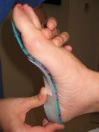
Figure 1: Orthotic with a tight fit to the arch
Why Your Orthotics Should Conform Very Close to the Arch of Your Foot (most of the time)
One of the major problems we see with many foot orthotics is that they simply do not conform close enough to the arch of the foot to provide the best outcome for the patient.
There are many studies showing that for a majority of foot problems, foot orthotics should conform extremely close to the arch of the foot.1-11 These are called Total-Contact Foot Orthotics (TCFOs).
Figure 1 shows how a total contact orthotic will match the arch of the foot. Note that there is no gap between the arch of the foot and the orthotic.
Why many orthotics do not work as well as they should?
Unfortunately, many – if not most – foot orthotics are designed so that they gap excessively from the arch of the foot. The reason for this is that unless the orthotic is made correctly, those orthotics that gap from the foot are more forgiving and less likely to cause arch irritation.
If your orthotics come from someone who Is not very skilled in orthotic therapy or is not familiar with recent research on orthotic function, they often prescribe orthotics that are not total contact so that they do not have to deal with any fit issues. Unfortunately, that means the orthotics you receive will not effectively control your symptoms.
Total contact orthotics should be extremely comfortable
If they are made correctly, however, TCFOs are actually more comfortable than standard orthotics.
Studies have confirmed that TCFOs are superior at spreading pressure over a larger area so no one part of the foot has too much pressure on it. To ensure proper fit and comfort, TCFOs should be prescribed only by well-trained and experienced practitioners.
Should all orthotics be total contact?
No. While the most common foot conditions (see the list below) respond best to total contact orthotics, some conditions require an orthotic that gap somewhat from the arch of the foot. An example would be an unstable ankle prone to sprains. In this situation an orthotic that conforms too close to the arch could increase the risk of an ankle sprain.
Comfort Guaranteed
Dr. Hale and Dr. Huppin are both experts at prescribing, casting and troubleshooting all foot orthotics, including total contact foot orthotics. Comfort of your orthotics is 100% guaranteed. Contact us today for an appointment in our Seattle office.
Conditions Treated with Total Contact Foot Orthotics
TCFOs have been shown to be far superior in treating the following problems:
- Arch and heel pain (plantar fasciitis and heel spurs)
- Pain under the ball of the foot (metatarsalgia)
- Bunions
- Big toe joint arthritis
- Neuromas
- Midfoot arthritis
- Calluses under the ball of the foot
- Medial knee pain and arthritis
- Top of foot pain
- Ankle pain / arthritis
Medical Studies Supporting the Use of Total Contact Orthotics
- Mueller MJ, Lott DJ, Hastings M. Phys Ther. 2006 Jun;86(6):833-42. Efficacy and mechanism of orthotic devices to unload metatarsal heads in people with diabetes and a history of plantar ulcers.
- Leslie C. Trotter and Michael Raymond Pierrynowski Changes in Gait Economy Between Full-Contact Custom-made Foot Orthoses and Prefabricated Inserts in Patients with Musculoskeletal Pain: A Randomized Clinical Trial J Am Podiatr Med Assoc 2008 98: 429-435
- Chalmers AC, Busby C. J Rheumatol. 2000 Jul;27(7):1643-7. Metatarsalgia and rheumatoid arthritis–a randomized, single blind, sequential trial comparing 2 types of foot orthoses and supportive shoes.
- Leslie C. Trotter and Michael Raymond Pierrynowski The Short-term Effectiveness of Full-Contact Custom-made Foot Orthoses and Prefabricated Shoe Inserts on Lower-Extremity Musculoskeletal Pain: A Randomized Clinical Trial J Am Podiatr Med Assoc 2008 98: 357-363
- Roukis, et. al. Position of the first ray and Motion of the First MTP. 1996 JAPMA. Vol 86:11
- Gross MT, Byers JM, Krafft JL, Lackey EJ, Melton KM: The impact of custom semirigid foot orthotics on pain and disability for individuals with plantar fasciitis. J Ortho Sp Phys Ther, 32:149-157, 2002.
- Effectiveness of Different Types of Foot Orthoses for the Treatment of Plantar Fasciitis J Am Podiatr Med Assoc 2004 94: 542-549
- Optimum position of metatarsal pad in metatarsalgia for pressure relief.
- Hsi WL, Kang JH, Lee XX. Department of Rehabilitation, National Taiwan University Hospital, Taipei, Republic of China. Am J Phys Med Rehabil. 2005 Jul;84(7):514-20.
- Powell M, Seid M, Szer IA: Efficacy of custom foot orthotics in improving pain and functional status in children with juvenile idiopathic arthritis: A randomized trial. J Rheum, 32:943-950, 2005.
- Slattery M, Tinley P: The efficacy of functional foot orthoses in the control of pain and ankle joint disintegration in hemophilia. JAPMA, 91:240-244, 2001.
- Li CY, Imaishi K, Shiba N, Tagawa Y, Maeda T, Matsuo S, Goto T, Yamanaka K: Biomechanical evaluation of foot pressure and loading force during gait in rheumotod arthritic patients with and without foot orthoses. Kurume Med J, 47:211-217, 2000.
